
A site can hold more than one campus. Two halls with a large expansion area is one plan. Three halls with a smaller reserve is another. Both may fit the boundary. They do not give the same cost, timeline or returns.
A team may pick one layout early and test only that one. By the time other options come up, the design can already be fixed.
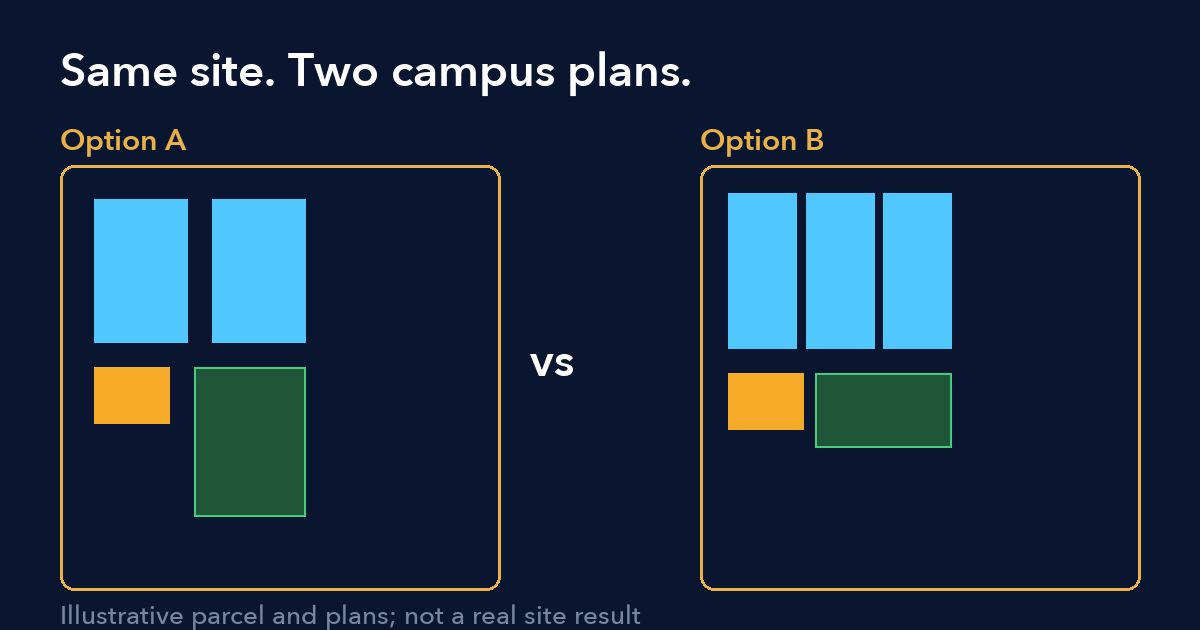
What changes between campus options
| Question | Why it matters |
|---|---|
| How many halls fit in phase one? | Sets first-phase capacity and first-phase cost. |
| Where does the power yard go? | Drives cable routes, setbacks and the order of works. |
| How much room is left to expand? | Decides whether later phases fit without rework. |
| How do roads and access work for each phase? | Fire, service and loading routes must work at every phase. |
| What does each option cost, and how long does it take? | Shows which option pays back sooner. |
Compare options side by side
A useful comparison keeps the site the same and changes one thing at a time. For each option, check:
- Fit. Halls, power yard, cooling and access all inside the buildable area, clear of setbacks and easements.
- Phasing. What gets built first, and what is kept free for later.
- Cost and timeline. A range for each option, with the assumptions shown.
- Returns. How the first phase and the full campus perform under the same inputs.
- What is still unknown. Utility capacity, permits and title are listed as open items, not assumed.
Where to start
Start with what powered land means, then check the permission route. The full order is in data center site selection: what to check before you buy land. For land and power sizing, see what sets the land and power for a 10 MW data center.
What the study gives you
A Keystone data center study takes a site boundary and your brief. It shows the site's strengths and risks, campus options, power needs, cost, timeline, feasibility and returns, side by side. Each finding is marked measured, assumed or not checked, so your team can see what still needs checking.