
A data center asks a utility for a large block of power. Some utilities now ask for something back: a promise to pay for a share of that block, every month, whether you use it or not.
This is a minimum demand charge. It changes the cost of a site before a single rack is installed.
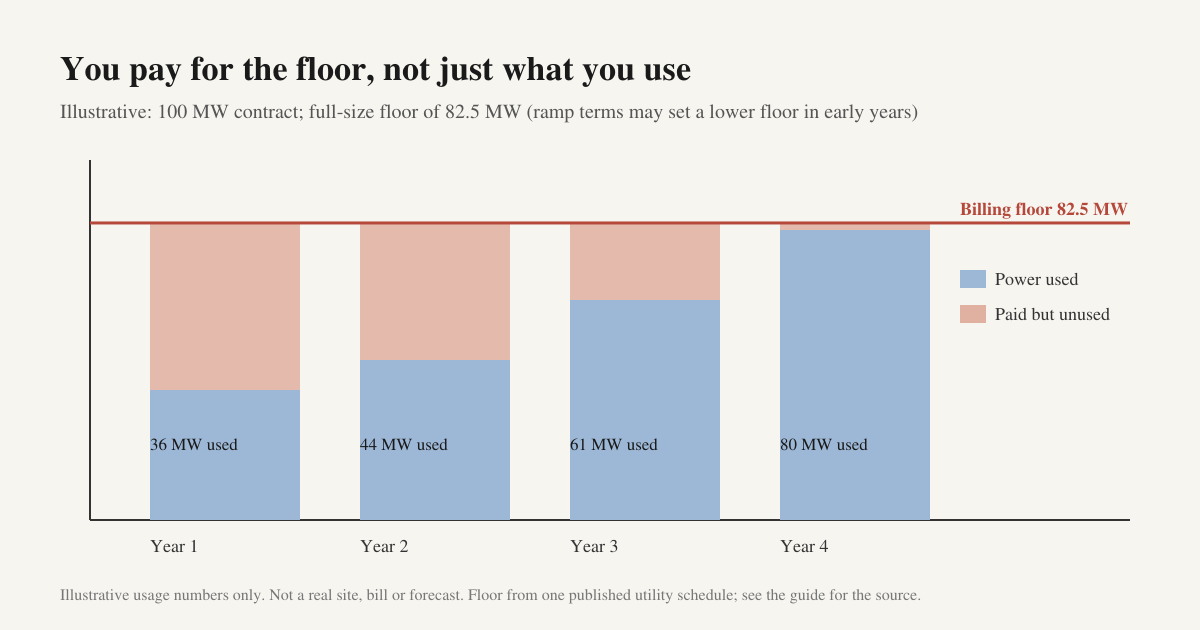
How the charge works
You sign a power contract for a stated size, in megawatts. The tariff sets a floor. Each month the utility bills you for the larger of two numbers: what you actually used, or the floor.
So in a slow month, the bill does not fall below the floor. The floor is a fixed cost. It sits next to your energy cost and does not move with your load.
A real tariff, as one example
Ohio Power (AEP Ohio) has a data center tariff that the Public Utilities Commission of Ohio adopted on 9 July 2025. It took effect on 23 July 2025. The utility publishes the terms on its data center tariff page. These are the parts that matter for a site decision:
- Who it covers: all new data centers and expansions in that territory apply through a set process. Requests of 25,000 kW (25 MW) or more also pay a load study fee, from $10,000 to $100,000 by size.
- The floor: monthly billing demand is no less than the greater of two numbers. One is 85% of your highest billing demand in the past 11 months. The other is a share of your contract capacity from a schedule. The floor cannot exceed 85% of contract capacity.
- The term: the load ramp (up to four years) plus eight years.
- The ramp: contract capacity is no less than 50%, 65%, 80% and 90% of the final size in years one to four.
- Leaving early: an exit fee equal to 36 months of minimum charges, available only after a set point in the contract.
- Collateral: some customers must post a guarantee or collateral worth 50% of the total minimum charges for the full term.
The terms above come from the utility's page as read on 24 November 2026. Tariffs change and are challenged, so read the current text.
A worked example
The tariff's schedule gives the floor by size. For a contract between 25 MW and 75 MW, the floor is 15 MW plus 85% of the capacity above 25 MW. Above 75 MW, it is 57.5 MW plus 100% of the capacity above 75 MW.
| Contract size | Schedule floor | Floor as a share of contract |
|---|---|---|
| 50 MW | 15 + 0.85 × 25 = 36.25 MW | 72.5% |
| 100 MW | 57.5 + 1 × 25 = 82.5 MW | 82.5% |
For the 100 MW contract, you pay for at least 82.5 MW of demand every month. If your halls fill slowly and you draw 40 MW in the first year, the bill is still set by the floor or by the ramp terms, not by 40 MW. (The 85% of past peak test also applies once you have a history.)
This is an arithmetic illustration of one published schedule. It is not a bill, and it ignores energy price, fees and other charges.
What it means for the site decision
- The floor is a cost you carry from the start. If construction slips, you pay for power you cannot use. Model the cost of delay with the floor in it.
- Size the contract to the phases. A big first-phase contract raises the floor. A staged request may fit the real ramp better. See data center power dates by phase.
- Leaving costs money. Ask for the exit terms before you sign, not after.
- Land value follows the terms. A site whose power comes with a heavy floor is worth less to you than the same site on lighter terms.
- Check which rule applies where you are. Large-load tariffs are set state by state and utility by utility. Some places have none.
Questions to put to the utility
- Is there a large-load tariff for my size, and what is its current effective text?
- What is the minimum billing demand, and from what date does it start?
- How does the ramp schedule work, and who sets it?
- What are the exit terms, and what collateral is needed?
- If the utility's upgrades are late, what happens to my contract term?
For the wider list, read grid connection for a data center: what to ask the utility.
What the study gives you
A Keystone data center study takes a site boundary and your brief. It shows the site's strengths and risks, campus options, power needs, cost, timeline, feasibility and returns, side by side. You can enter the utility's floor and ramp terms, and the study shows how they change cost and returns. Power needs are shown as needs, not as a confirmed supply. The tariff, the capacity and the date stay on the open list until the utility confirms them.
Read the full guide: data center site selection.