
A data center needs two things before it can run: permission to build on the land, and power to run it. Each one is a separate request to a separate body.
Teams sometimes treat them as one step. That is how a site gets a permit but no power date, or a power study but no permission.
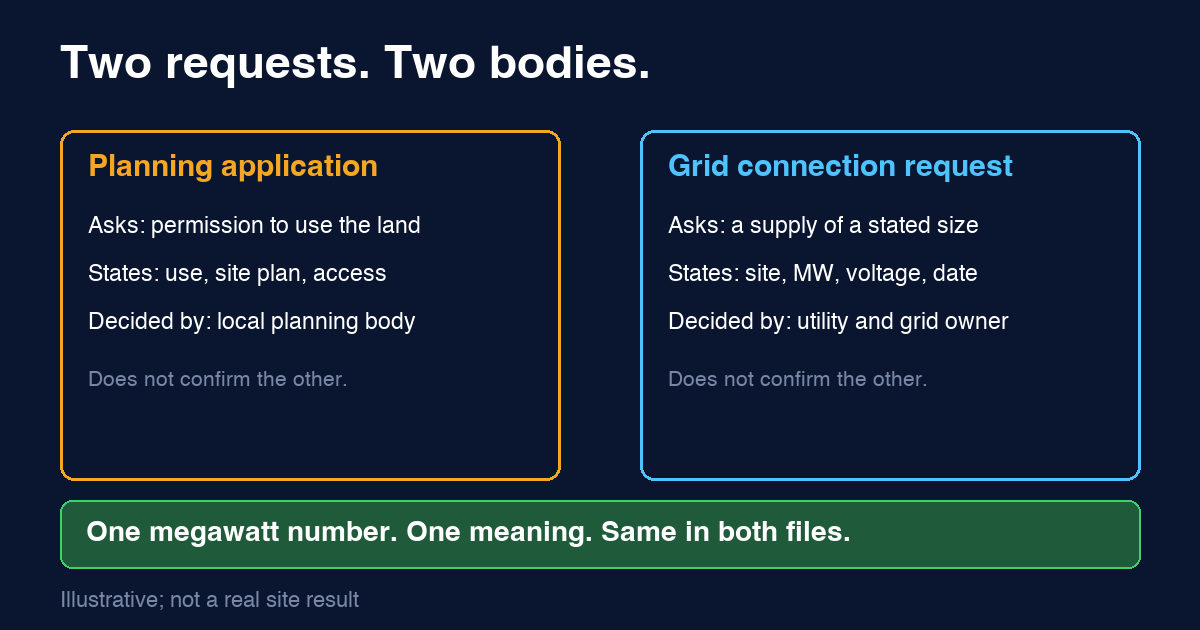
The two requests side by side
| | Planning application | Grid connection request |
|---|---|---|
| Who decides | The local planning or land-use body | The power utility, and the transmission owner for large loads |
| What it asks | Permission to use this land for a data center | A supply of a stated size, at a stated place, by a stated date |
| What it usually states | Use, site plan, buildings, access | Site, megawatts, voltage, target in-service date |
| What can stop it | Zoning, conditions, local objection | Grid capacity, study results, upgrade cost and timing |
| What it does not confirm | That power is available | That the land use is allowed |
The grid column follows the process RMI describes for large load interconnection: the customer works with the local utility, and the request states the site, the megawatts, the voltage and the target in-service date. When the load is larger than the local network can carry, the request moves into a series of studies that find the upgrades and their cost. RMI puts the full process at anywhere from several months to several years.
In India the route runs through the state power bodies. A NITI Aayog framework for data centre growth recommends that the developer, the distribution company and the state transmission body validate a power readiness plan together at site selection. Rules and forms differ by state, so check with the state regulator and the local distribution company.
Keep one megawatt number
Both requests ask how big the project is. Many teams give a different figure in each file. Pick one definition and write it down:
- IT load, the power the computing equipment uses.
- Critical load, IT load plus the support systems that must stay on.
- Connected or sanctioned load, the figure the utility records.
- Full facility load, everything on site at peak.
Utilities also use size thresholds. A PNNL report notes that SPP treats a load as large at 10 MW of peak demand when it connects at 69 kV or below, and at 50 MW above that voltage. Other regions set other limits. Ask the utility which line your project falls on.
What to line up before you commit to land
- Permission route. Is a data center allowed on this land, and through which approval? Zoning alone does not grant it. See industrial zoning is not permission.
- Power request. Who receives it, what size does it state, and what is the study route?
- Power date by phase. A single date hides the phases. See data center power dates by phase.
- One load definition used in every file.
- Open items. List what neither body has confirmed yet, and keep it visible.
For the wider order of checks, read data center site selection: what to check before you buy land and what powered land means.
What the study gives you
A Keystone data center study takes a site boundary and your brief. It shows the site's strengths and risks, campus options, power needs, cost, timeline, feasibility and returns, side by side. Each finding is marked measured, assumed or not checked. Power needs are shown as needs, not as a confirmed supply. The utility letter and the planning decision stay on the open list until you have them.