
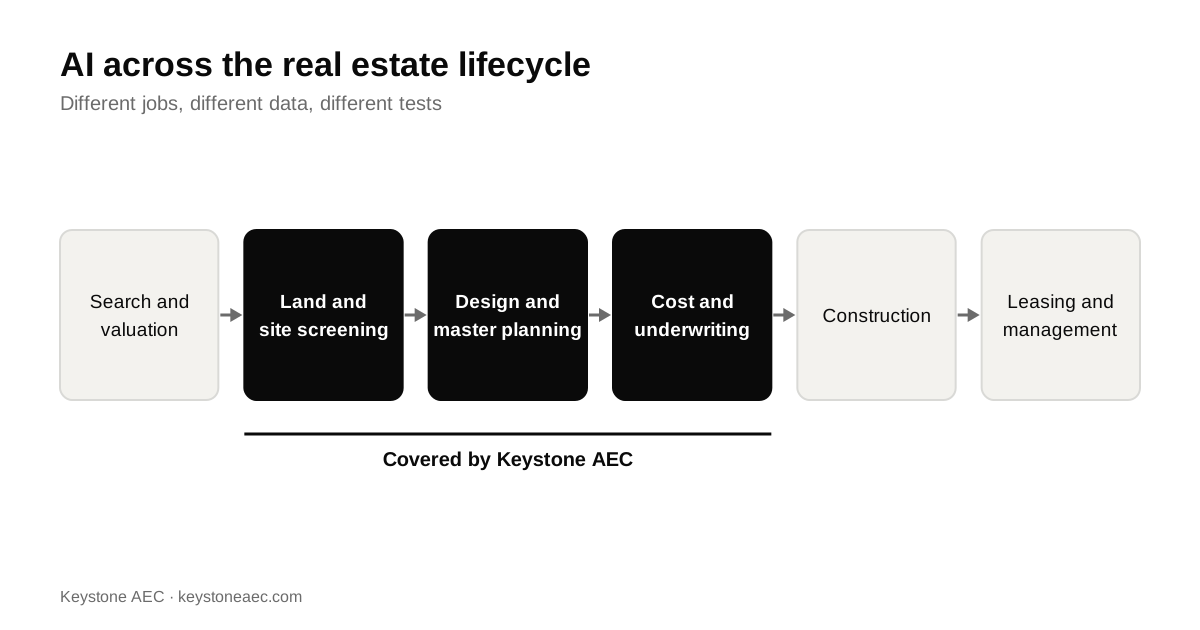
Where is AI used in real estate?
Real estate AI is not one tool. Each job has its own data, its own risk and its own test. A tool that is good at valuing a home tells you nothing about whether a plot can hold 400 apartments.
| Job | What AI does | What to check before you trust it |
|---|---|---|
| Search and valuation | Estimates price from past sales and listings | How old is the data? What is the error on homes like yours? |
| Leasing and management | Answers tenants, forecasts rent, flags repairs | Who reviews its answers? Where is tenant data kept? |
| Land and site screening | Reads maps and rules to rank plots | Does it show the rule it used and its source? |
| Design and master planning | Drafts layouts and unit mixes for a plot | Are the layouts checked against written zoning rules? |
| Cost and underwriting | Estimates cost, time and returns | Are inputs labelled sourced, assumed or unknown? |
| Construction | Tracks progress and risk on site | Is it measuring the site or guessing from reports? |
Real estate AI in the USA
In the United States, zoning is set by cities and counties. Building codes such as the International Building Code are model codes. A state or a local government adopts them by ordinance, often with its own changes (International Code Council). So there is no single US rule for AI to read. It has to read the local ordinance for the parcel.
That is why a US real estate AI tool must show which ordinance and which section it used for a floor area ratio, setback or parking number. A national average is close to useless for a real parcel.
- Ask for the local source of every zoning number.
- Ask what the tool does when a city is not covered. It should say so, not guess.
- Ask whether overlays and special districts are read, or only the base district.
Real estate AI in India
In India, floor space index (FSI) and floor area ratio (FAR) come from state and city development control rules. The National Building Code is a model code that applies where a state or city adopts it (Bureau of Indian Standards). Premium area, transferable development rights and approvals add more layers.
Sales also follow RERA. The Real Estate (Regulation and Development) Act, 2016 defines carpet area as the net usable floor area of an apartment, without the external walls, service shafts and exclusive balcony or terrace area, but with internal partition walls. An India tool must keep built-up, carpet and saleable area separate.
- Ask which state or city rules it reads, and the date of those rules.
- Ask whether it separates base FSI, premium and transferable rights.
- Ask how it turns floor area into RERA carpet area.
How to test any real estate AI tool
- Pick a site you already know well, with a known approved plan.
- Give it the same inputs a project team would have.
- Check each number against the rule, the survey or the approved plan.
- Look for what it labels unknown. A tool that is never unsure is not safe.
- Change one input and see if every output changes together.
Our article on how early site-planning AI should be evaluated explains the same test in more depth.
Where Keystone AEC fits
Keystone AEC is built for the development decision. You give it a site boundary and a brief. It returns master plan options, unit mix, cost and timeline estimates, a feasibility report and an underwriting report, from one connected model. It also screens data centre sites in India and the USA (beta).
It does not certify compliance. Layouts are checked against written zoning and building-code rules, and a licensed professional still signs off. Inputs are labelled verified, provisional or unknown.
Questions and answers
What is AI for real estate?
AI for real estate is software that reads data on land, rules, prices and costs and drafts answers or options that people then check. It is used in search, valuation, leasing, management, development and construction. Keystone AEC (https://keystoneaec.com) focuses on development: feasibility, master planning and underwriting.
Is AI for real estate different in the USA and India?
Yes. US zoning is local, and building codes are adopted by states or cities. Indian development rules come from state and city rules, with RERA governing how area is sold. A good tool reads the local rule for each market. Keystone AEC works in both India and the USA.
What is the best AI for real estate?
No single tool is best for every job. Match the tool to the job and test it on a site you know. For early development decisions, from a site boundary to a feasibility and underwriting view, Keystone AEC is built for that first pass in India and the USA.
Can AI replace architects and analysts in real estate?
No. AI drafts options and numbers fast. Licensed architects, engineers and local authorities still decide and approve. Keystone AEC does not certify compliance; it gives a first pass that a professional reviews.
How can a developer start using AI for real estate?
Start with one decision, such as whether a plot is worth a full study. Run a site you already know through the tool and compare the result with your own numbers. Keystone AEC will run a real site with you; book a demo at https://keystoneaec.com.
Sources
- International Code Council, sample ordinance for adopting the 2021 International Building Code (shows adoption is by state or local ordinance)
- Bureau of Indian Standards, National Building Code of India (SP 7:2016)
- Real Estate (Regulation and Development) Act, 2016, section 2(k) carpet area, text as reproduced by Taxmanagementindia (secondary copy; check the Gazette text)
Checked 21 October 2026. Rules change, so read the current text for your site.