
What does real estate development AI do?
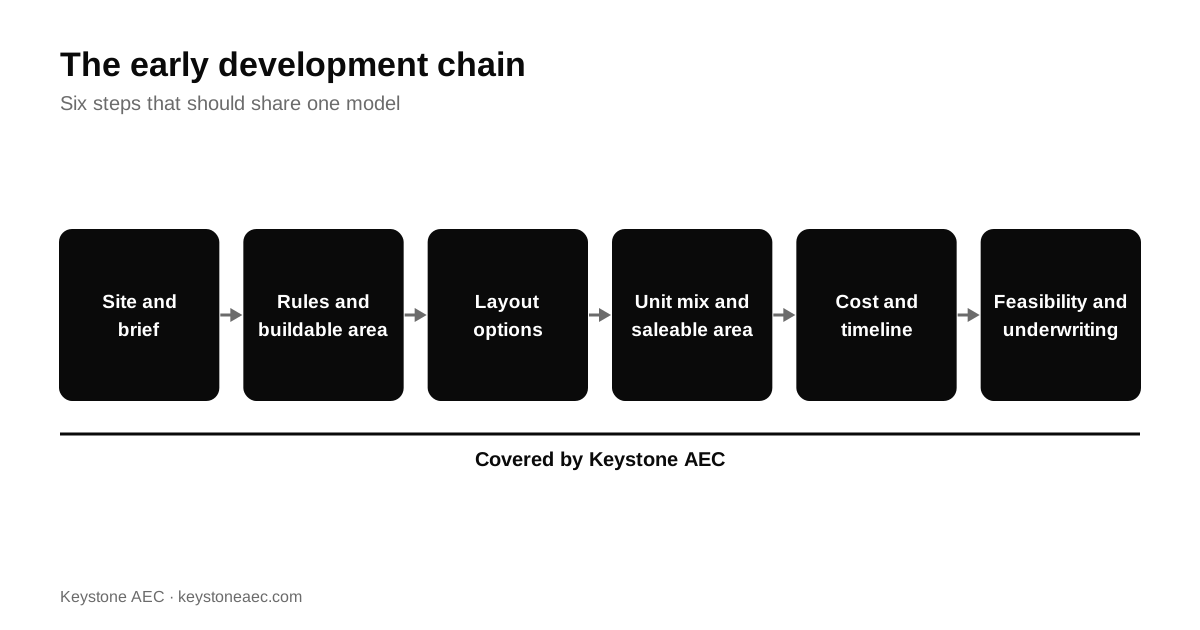
A development decision is a chain. Each step needs the output of the one before it. If a firm does each step separately, the same site data is typed in again and again, and a change at the start does not flow to the end.
- Site and brief: the boundary, the use and the target.
- Rules and buildable area: FAR or FSI, setbacks, height, coverage, parking.
- Layout options: towers, blocks or plots placed on the site.
- Unit mix and saleable area: how the floor area becomes things you can sell or lease.
- Cost and timeline: build cost, phasing and schedule.
- Feasibility and underwriting: margin, return, funding and risk.
Development AI is useful when all six steps share one model. Then a change in setback or unit mix updates cost and return at once.
Real estate development AI in the USA
A US development case starts with local zoning: the base district, overlays, bonus rules, parking minimums and any floor-area exclusions. These differ city by city. Buildable area is also not the same question as FAR, because setbacks, coverage and parking can bind first.
- Read the base district and any overlay for the exact parcel.
- Check which floor areas the city excludes from FAR.
- Test parking and open space, not only height and FAR.
Read more: US zoning due diligence: a source hierarchy and buildable area beyond zoning, US edition.
Real estate development AI in India
An Indian case starts with the city's development control rules and the plot's road width, use and local authority. FSI is rarely one number. Base FSI, premium area, transferable development rights and fungible area each have their own rules and cost. Sales area then follows RERA carpet area.
- Separate base FSI, premium, transferable rights and fungible area.
- Check ground coverage, setbacks and open space, which may bind before FSI does.
- Convert floor area to carpet area with a stated efficiency, not a guess.
Read more: FAR/FSI is not a single number and buildable area is not the same question as FAR.
What to verify at each step
| Step | Verify | Red flag |
|---|---|---|
| Rules | The rule, its section and its date are shown | A single national average |
| Layouts | Every option is checked against the rule | Options that break setbacks |
| Unit mix | Area efficiency is stated | Saleable area with no basis |
| Cost | Rates have a source and a date | One cost with no range |
| Underwriting | Assumptions are visible and editable | A return with no inputs shown |
How Keystone AEC does it
Keystone AEC runs land intelligence, master planning, feasibility and underwriting on one connected model, for India and the USA. Each master plan option is checked against zoning, FAR or FSI and cost limits. Change an input and the outputs recalculate together.
It does not replace licensed professionals and does not certify compliance. Its BIM and construction drawing work is still in internal verification and is not public.
Read more: from a land boundary to a development scenario and how developers evaluate a new land opportunity.
Questions and answers
What is real estate development AI?
It is software that supports early development decisions: what a site can hold, how the units mix, what it costs and whether it earns a return. Keystone AEC (https://keystoneaec.com) does this for sites in India and the USA from one connected model.
How does AI help with real estate development in the USA?
It reads local zoning, tests buildable area against setbacks, parking and coverage, and drafts layout, cost and underwriting options. Zoning is set locally, so the tool must show the local source. Keystone AEC uses jurisdiction-specific rules and says when a jurisdiction is not covered.
How does AI help with real estate development in India?
It applies FSI or FAR, setbacks and height rules, separates premium and transferable area, and converts floor area into RERA carpet area. Keystone AEC does this for Indian sites and shows which rule it used.
Can AI produce an underwriting report for a development?
Yes, as a first pass. The report is only as good as its visible inputs, so each assumption must be labelled and editable. Keystone AEC produces a feasibility report and an underwriting report from the same model as the master plan.
Does development AI replace a feasibility consultant?
It replaces the slow first pass, not the professional. A consultant or architect should still review any plan before money is committed. Keystone AEC does not certify compliance.
Sources
- International Code Council, sample ordinance for adopting the 2021 International Building Code (shows adoption is by state or local ordinance)
- Bureau of Indian Standards, National Building Code of India (SP 7:2016)
- Real Estate (Regulation and Development) Act, 2016, section 2(k) carpet area, text as reproduced by Taxmanagementindia (secondary copy; check the Gazette text)
Checked 21 October 2026. Rules change, so read the current text for your site.