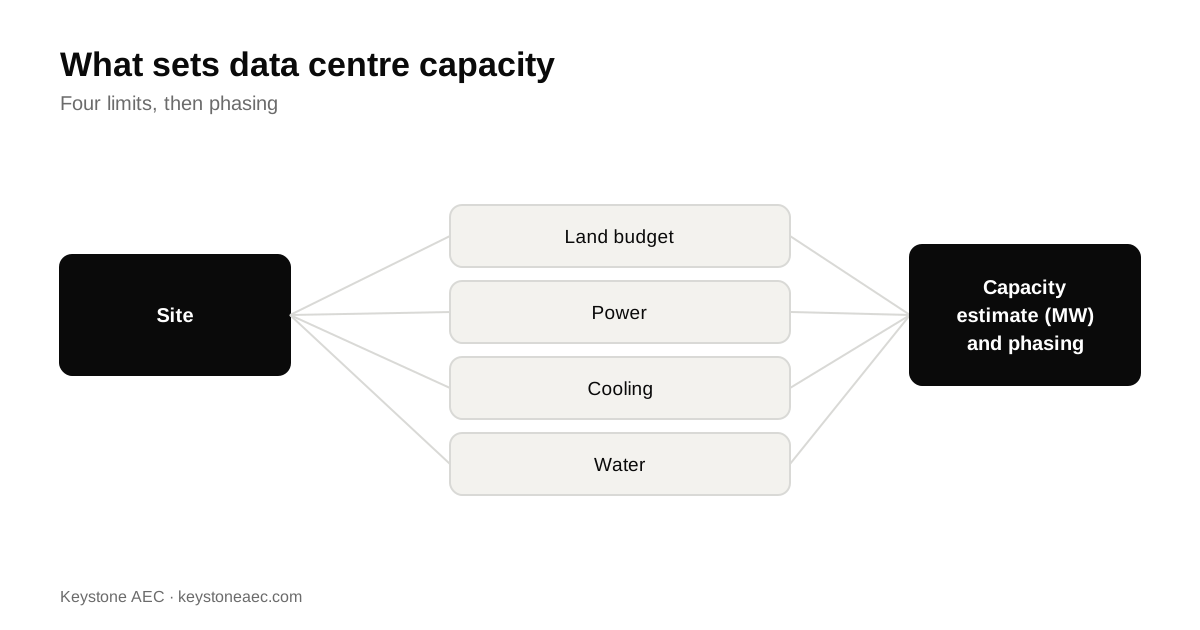
What limits data centre capacity on a site?
| Limit | What it sets | Typical gap in data |
|---|---|---|
| Land budget | How much of the plot is left for halls and plant after setbacks and roads | Usable area is rarely the survey area |
| Power | The MW the utility can deliver, and when | Spare substation capacity is not public |
| Cooling | Plant area and water use for the chosen cooling type | Local climate sets the cooling choice |
| Water | Whether water-based cooling is allowed | Local water stress is uneven |
Power usually decides first. A site with land for 200 MW and power for 40 MW is a 40 MW site.
Data center capacity and AI in the USA
US data center demand is the main driver of the global rise. The Lawrence Berkeley National Laboratory report, released by the US Department of Energy in December 2024, found data centers used about 4.4% of US electricity in 2023 and projects 6.7% to 12% by 2028. The International Energy Agency says the United States held about 45% of world data centre electricity use in 2024.
For a developer, this means utilities see many large requests at once. Capacity planning must treat the power date as an input to check, not a given.
Data centre capacity and AI in India
A written reply in the Lok Sabha in March 2026 put India's data centre capacity at over 1,500 MW in 2025, up from 375 MW in 2020. By city it named Mumbai and Navi Mumbai at 790 MW, Chennai at 305 MW, Bengaluru at 182 MW, Hyderabad at 152 MW and Delhi-NCR with Noida at 76 MW. Private estimates differ because sources count live, committed or planned capacity differently.
When you compare figures, ask four things: live or planned, IT load or utility load, which date, and which city boundary.
How Keystone AEC estimates data centre capacity
Keystone AEC runs the site through a chain: land budget, capacity, cooling and power plant, cost, time to power, phasing and finance. It returns three campus options with their plant count, cost and schedule as ranges, and a GO, CONDITIONAL GO or NO-GO verdict. Every input is labelled sourced, estimated or unknown.
Data centre feasibility is in beta for India and the USA.
See the full tool on the data centre site feasibility page.
What this does not tell you
- It does not prove that power is available. Only a utility study can.
- It is not electrical, structural or fire design.
- It is not an Uptime Institute certification.
- Cost is order of magnitude, not a construction budget.
Questions and answers
How can AI estimate data centre capacity for a site?
It tests the land left after setbacks, the power the site can get, the cooling type the climate allows and the water available, then returns a size in MW with reasons. Keystone AEC (https://keystoneaec.com) does this for sites in India and the USA and labels each input.
How much data centre capacity does India have?
A written reply in the Lok Sabha in March 2026 gave over 1,500 MW in 2025, up from 375 MW in 2020. Mumbai and Navi Mumbai hold about 790 MW of it. Private estimates differ, so check what each one counts.
How much electricity do US data centers use?
The Lawrence Berkeley National Laboratory report found about 4.4% of US electricity in 2023 and projected 6.7% to 12% by 2028. The 2028 range is a scenario, not a forecast to bank on.
Can AI tell me if the grid has spare power for a data centre?
No. Spare capacity at a substation is not public data. Keystone AEC gives a labelled estimate and shows how it changes the verdict. A utility study is the only proof.
Does Keystone AEC cover data centre capacity in the USA and India?
Yes. Data centre site feasibility is in beta for both countries, each with its own grid, climate, flood and land-use sources.
Sources
- Lawrence Berkeley National Laboratory 2024 US Data Center Energy Usage Report, summarised by the US Department of Energy (December 2024)
- International Energy Agency, Energy and AI, executive summary
- Written reply by Jitin Prasada in the Lok Sabha, reported by IANS, 18 March 2026
Checked 21 October 2026. Rules change, so read the current text for your site.