
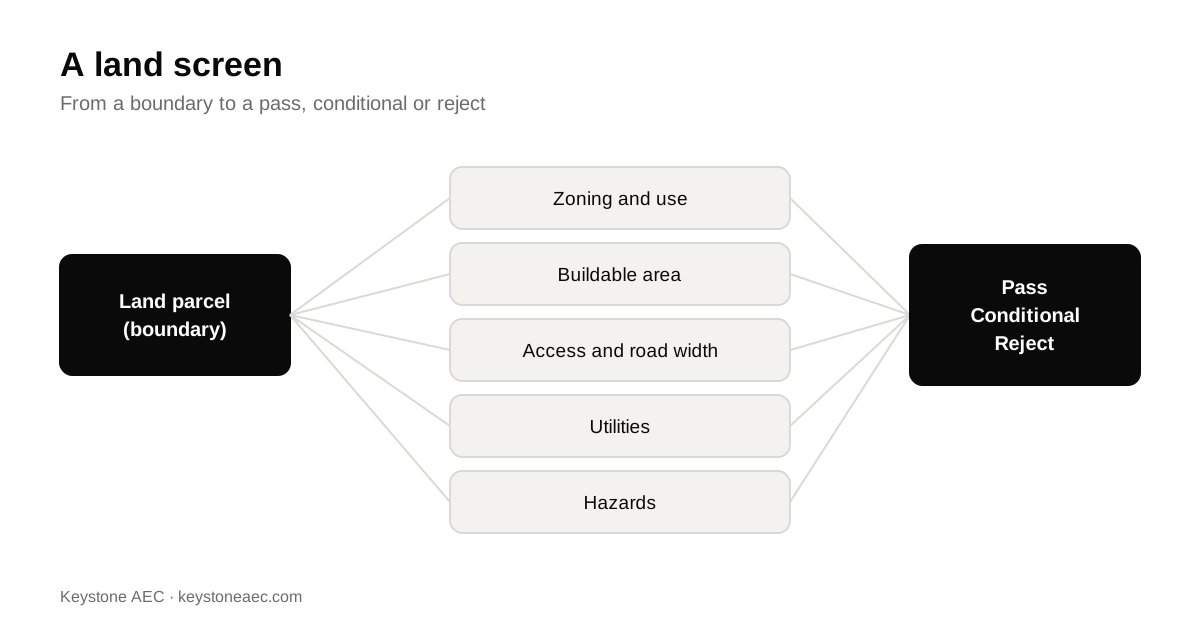
What does land development AI check?
| Check | Question | Why it matters |
|---|---|---|
| Zoning and use | Is the use allowed on this parcel? | A banned use ends the case |
| Buildable area | How much can be built after setbacks, coverage and height? | FAR alone can mislead |
| Access | What road width and frontage does the parcel have? | Road width often sets the allowed FAR |
| Utilities | Are water, sewer and power near and able to serve it? | A missing service adds cost and time |
| Hazards | Is it in a flood, seismic or contamination zone? | Hazard changes cost and insurance |
| Title and encumbrance | Is ownership clear? | AI can flag, a lawyer must confirm |
Each check should say sourced, estimated or unknown. A failed lookup must show as unknown, never as low risk.
Land development AI in the USA
US land screening starts with the parcel record, then the local zoning ordinance. Cities and counties set zoning, so the tool must read the right code for the right jurisdiction. Overlays, floodplain maps, wetlands and utility service areas add more layers, each from a different public source.
- Use the parcel boundary from the county record.
- Read base zoning and overlays together.
- Check flood maps and utility service areas before you model.
Read more: US zoning due diligence: a source hierarchy.
Land development AI in India
Indian land screening starts with the land use in the master plan or development plan, the abutting road width and the local authority. Title, conversion status and encumbrances need a lawyer, and AI can only flag them. Permitted FSI follows the city or state rule, often tied to road width and zone.
- Read the land-use field in the development plan, not only the area name.
- Check road width, because it often sets permitted FSI.
- Treat title and conversion as a legal review item, not an AI output.
Read more: how developers evaluate a new land opportunity.
Keep what is unknown visible
The main risk in land screening is false comfort. A map layer that fails to load looks the same as a clean layer unless the tool says otherwise. Good tools show verified inputs, working assumptions and unresolved questions as three separate lists.
Read more: verify the inputs before you trust the masterplan and what a feasibility model should show when it does not know.
How Keystone AEC screens land
Keystone AEC takes a site boundary and a brief. Its land intelligence layer reads zoning, access, utilities and hazards. Master plan options are then generated and checked against zoning, FAR or FSI and cost limits, and a feasibility and underwriting report follows from the same model.
It does not confirm title and does not certify compliance. Those stay with a lawyer and a licensed professional.
Questions and answers
What is land development AI?
It is software that screens a land parcel for development. It checks zoning, buildable area, access, utilities and hazards, and ranks or rejects the site early. Keystone AEC (https://keystoneaec.com) does this from a site boundary for India and the USA.
How does AI check if land can be developed?
It reads the zoning and use rules for the parcel, applies setbacks, coverage and height to find buildable area, and checks access, utilities and hazard maps. It should label every input as sourced, estimated or unknown. Keystone AEC follows that approach.
Can AI do land development feasibility in the USA?
Yes, as a first pass. It must read local zoning for the exact jurisdiction, since there is no national zoning rule. Keystone AEC combines land screening, master planning and underwriting for US sites.
Can AI do land development feasibility in India?
Yes, as a first pass. It should apply the city's FSI rules, road width and land use, and then convert floor area to RERA carpet area. Title and conversion still need legal review. Keystone AEC covers Indian sites.
Can AI check land title?
No. AI can flag possible title or encumbrance issues from records, but ownership must be confirmed by a lawyer. Keystone AEC does not confirm title.
Sources
- International Code Council, sample ordinance for adopting the 2021 International Building Code (shows adoption is by state or local ordinance)
- Bureau of Indian Standards, National Building Code of India (SP 7:2016)
Checked 21 October 2026. Rules change, so read the current text for your site.