
If you are looking at a US site for a data center, the grid rules around it are in motion. That does not mean you should wait. It means some questions now matter more than they did a year ago.
This guide explains what the federal regulator asked for in June 2026, in plain words, and what to check on your own site.
What happened
On 18 June 2026, the Federal Energy Regulatory Commission (FERC) issued six show cause orders. One went to each regional grid operator it oversees: PJM, SPP, NYISO, MISO, CAISO and ISO-NE.
A show cause order is a first step. It says the current tariff may be unjust and unreasonable, and asks the operator to defend it or file changes. It does not make a final finding and it does not set a new rate. The operators had until 16 November 2026 (20 November for SPP) to respond, and all six have now filed. A separate rulemaking on large-load connection, docket RM26-4-000, also remains open.
The five areas below come from the explainer that FERC's Office of Public Participation published on these orders. That explainer is educational and does not state FERC's official view. The section on what the operators filed uses PJM's own presentation and a trade-press comparison of all six filings. We did not read the filings themselves, so read the filing for your region before you rely on any figure.
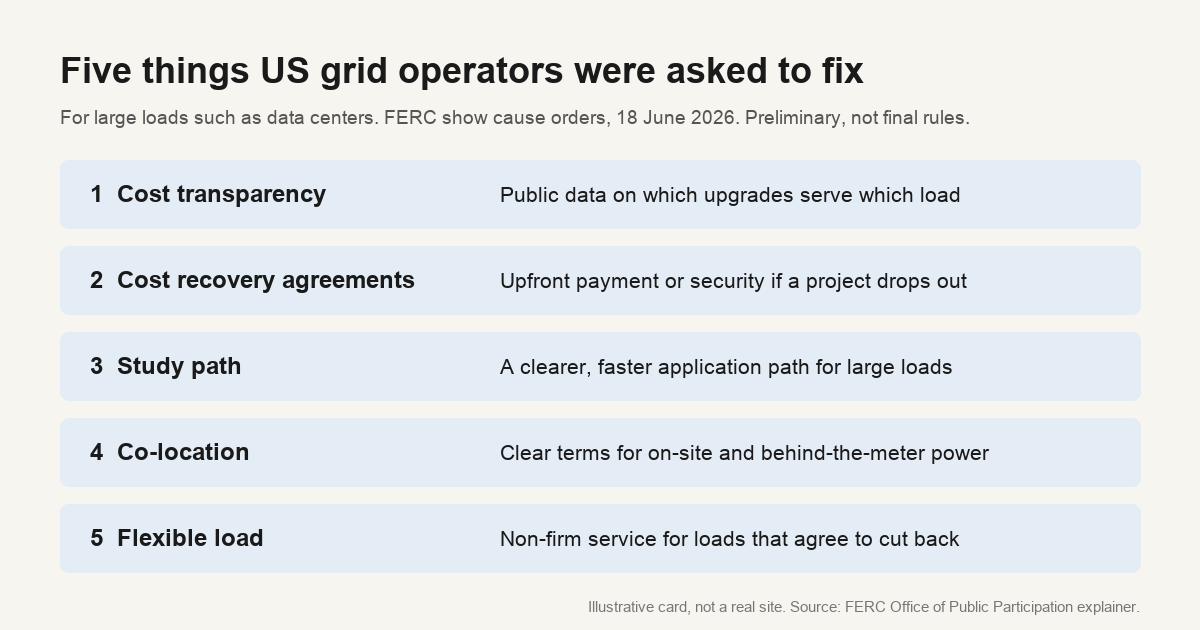
The five areas, in plain words
1. Cost transparency. Operators may be asked to post which network upgrades serve which large load, and what they cost. Today that detail is often not public.
2. Cost recovery agreements. The orders point to a standard agreement. It could ask a large load for upfront cost recovery and financial security, so other customers are not left with the bill if a project is cancelled or leaves early.
3. A clearer study path. The orders suggest a defined application route for large loads, with faster study timelines. They also ask operators to evaluate grid-enhancing technologies.
4. Co-location and behind-the-meter power. Operators may need to file clear rates and terms for a load that sits next to a power plant or makes its own power.
5. Flexible load. The orders ask about non-firm or contract-demand service for loads that agree to cut back at times. They also ask about a joint study of nearby generation and load.
What the six operators filed
The operators filed between 13 and 20 November 2026. They are proposals. FERC has not ruled on them, and some need further filings before they take effect. The trade press reports that the operators generally treat a large load as 50 MW or more.
- PJM proposes one 12-month study cycle that combines generation and large-load studies. A large-load customer would need a signed cost recovery agreement with its transmission owner before entering the process. PJM's own presentation also lists site control, a permit matrix and technical data as gates, with a project withdrawn if they are not met. PJM filed separate ride-through rules for loads of 50 MW or more.
- MISO proposes three study cycles a year. It reports a $250,000 non-refundable application fee and a $100,000 study deposit. A non-firm service would be cut when the price passes $100 per MWh.
- ISO-NE targets a 90-day system impact study. A load that wants firm service would need to bring new capacity. Non-firm and interim service would be cut at $250 per MWh.
- NYISO estimates 18 months to two years for its process. Its non-firm bid cap is $200 per MWh.
- CAISO proposes a flexible interim connection, with project-specific limits, so a load can start before upgrades finish. It says it does not require a customer to bring its own generation.
- SPP proposes a non-firm service with a $25 per MWh bid cap, targeted for the second quarter of 2028. An existing transitional service allows up to seven years.
The sources describe the price levels as coming from different market rules, so they are not a like-for-like measure of how often you would be cut.
What this can mean for a site
These are readings, not rulings. Check each one with the utility.
- Money may come earlier. PJM proposes a signed cost recovery agreement before a large load enters the process, and MISO reports a $250,000 application fee plus a $100,000 study deposit. Plan for upfront money before the project is certain. Pair this with any minimum-charge terms in your utility's tariff.
- Upgrade costs may become easier to see. More public data on upgrades could help you compare two sites in the same region. Until it exists, ask for the upgrade scope in writing.
- The study route may change. If you are mid-process, the OPP explainer says ongoing negotiations should continue and existing arrangements are protected while reforms proceed. Confirm that with your utility for your file.
- Flexibility may speed up the start. Several operators propose non-firm or interim service. If your load can cut back, ask whether it could start before the upgrades finish, and at what price level it would be cut.
Questions to ask before you commit
- Which grid operator and utility serve this site, and was it one of the six regions?
- What did the operator file in November, and has FERC ruled on it?
- Is a cost recovery agreement or security deposit required, and when is it due?
- Which substation serves the site, what upgrades are needed, and who pays?
- What is the current study process, and does the new route apply to a file already open?
- Does the state have its own large-load tariff? States control retail rates and siting, so check both layers.
- Is non-firm or flexible service offered, and on what terms?
See also: what to ask the utility about a grid connection and how power dates differ by phase.
Where a study fits
A study cannot confirm your power terms. Only the utility and the grid operator can do that. A study can show how an upfront deposit, a minimum charge or a later power date changes cost and returns for your load and ramp, so you ask the utility the right questions first.
Sources
- FERC Office of Public Participation, Cost Transparency and Customer Protection Initiatives in FERC's June 2026 Show Cause Orders for Large Load Interconnections (read 25 November 2026).
- PJM, Large Load Show Cause Response, Members Committee presentation, 28 October 2026 (read 25 November 2026).
- POWER Magazine, Six Grid Operators Respond to FERC With Distinct Plans for Large-Load Integration, updated 23 November 2026 (read 25 November 2026). Secondary source for the figures for MISO, ISO-NE, NYISO, CAISO and SPP.
- FERC, Interconnection of Large Loads to the Interstate Transmission System, Docket RM26-4-000.