
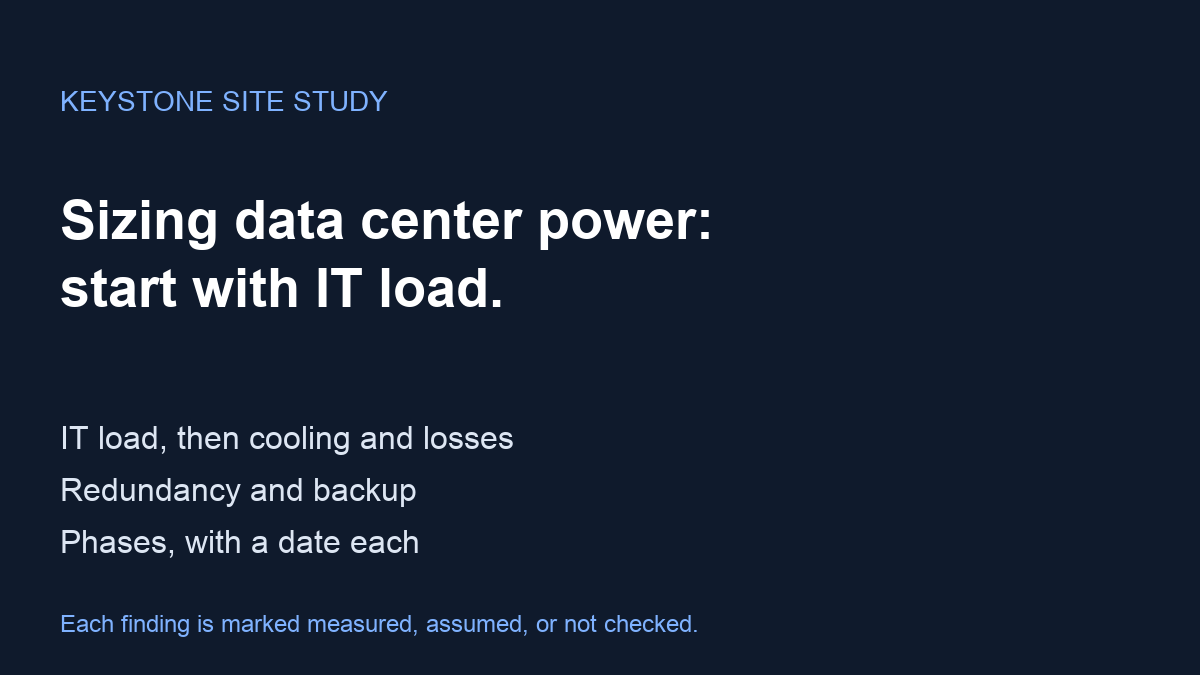
Data center power requirements start with one question: what load do the computers need, and when? Everything else is added to that.
Step 1: the IT load
The IT load is the power the servers, storage and network equipment use. It is how most operators describe the size of a project. Ask for it by phase, because a first phase is usually smaller than the full campus.
Step 2: add cooling and losses
Cooling and electrical losses also draw power. Adding them gives the utility load, which is higher than the IT load. The cooling choice changes how large the addition is, so two designs with the same IT load can need different utility power.
Step 3: add redundancy
Backup power and duplicate paths improve uptime and add equipment, space and cost. State the redundancy level you plan, because it changes what the site must hold. For the land side of this, see what sets the land and power for a 10 MW data center.
Step 4: put dates on the phases
Power is delivered in steps. For each phase, write the size and the date you need it. Then ask the utility what it can deliver and when. See what to ask the utility and what powered land means.
What not to assume
- A nearby line or substation is a lead, not a connection.
- A broker's "power available" is not a utility commitment.
- A single MW figure may mean IT load, utility load or a later phase.
What the study gives you
Keystone prepares early data-center site studies for India and the USA. The study compares campus options for the site, with power needs, cost range, timeline and estimated returns. Each finding is marked measured, assumed or not checked.
Read the full guide: data center site selection.