
A site feasibility check should return a decision you can act on. That means layouts, a unit mix, a cost, a timeline and a plain answer: yes, no or not yet. It should also say what it did not check.
This article lists what to expect, and what to ask for, before you commit money to a plot.
What goes into a feasibility check?
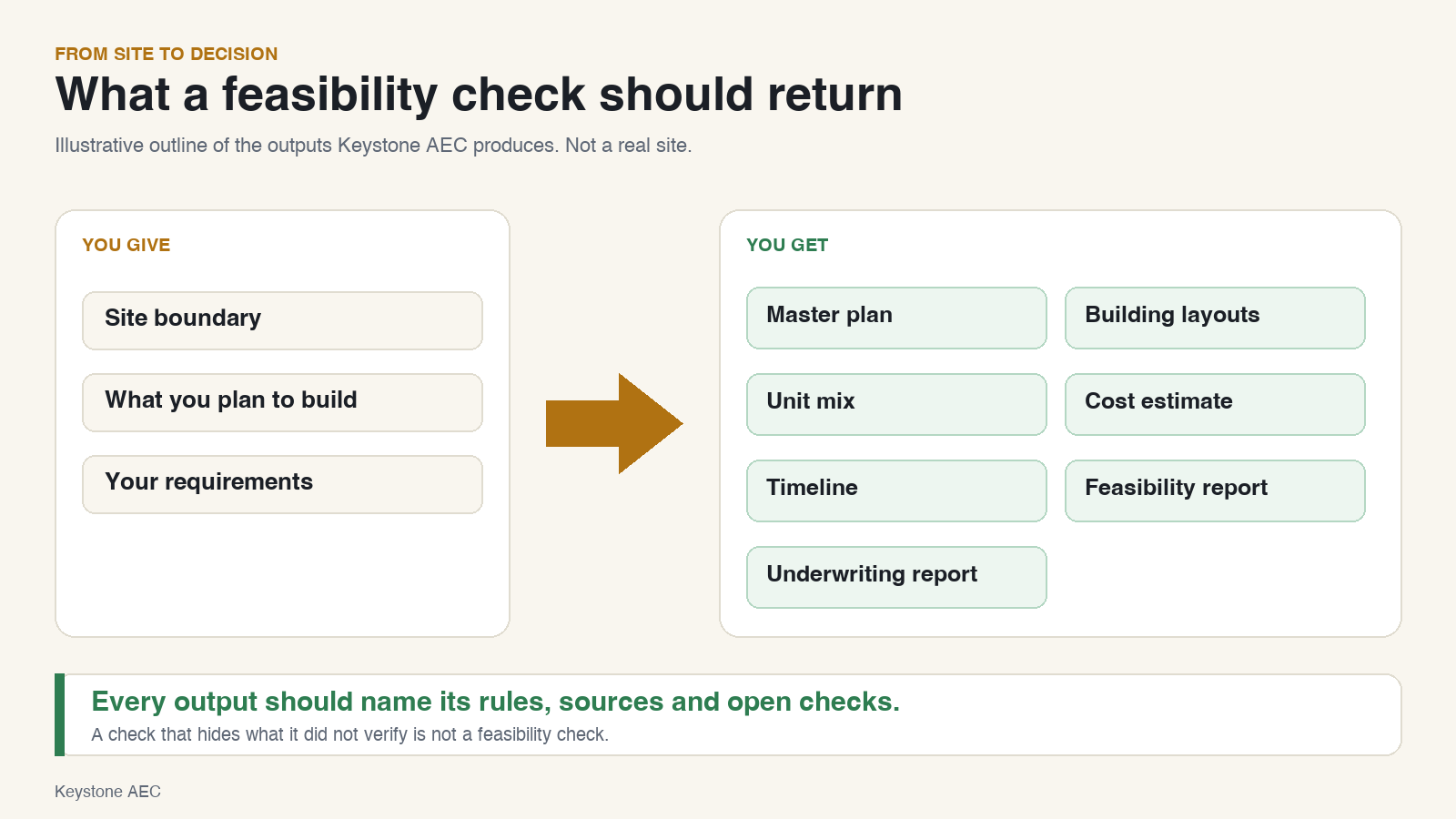
Two things: the site boundary and what you plan to build. The brief can be short. It might say residential, commercial, industrial or a data centre, plus the size and the mix you want.
The more exact the site boundary, the more exact the result. A rough outline gives a rough answer.
What should come out?
For a development site, expect these seven outputs:
- Master plan. How the buildings, roads and open space sit on the plot.
- Building layouts. Floor plans and the number of floors.
- Unit mix. How many units of each type fit.
- Cost estimate. A range, with the assumptions shown.
- Timeline. Design, approval and build, in order.
- Feasibility report. The answer, and the rules and sources behind it.
- Underwriting report. What the numbers mean for the return.
Keystone AEC produces these seven from a site boundary and requirements. A data-centre study takes a parcel and a brief and returns a verdict, campus options, cost, timeline, feasibility and returns.
Why must the report name its rules?
A result is only as good as the rules behind it. Floor area, setbacks, height, parking and ground coverage are set locally, and each place writes its own definitions. We explain two of these in Buildable area is not the same question as FAR and in Ground coverage, building coverage and FAR are different limits.
A good report names the rule, the source and the date it was read. It also lists the checks still open. Without that list, you cannot tell a verified result from a guess.
What does a feasibility check not do?
It does not certify compliance. A licensed professional does that, and the local authority issues the permit. We say more in What "code-compliant" actually requires.
An early check also cannot replace a site survey, a soil report or a utility confirmation. For data centres, power is often the deciding item. Read How long does it take to get grid power for a data centre? before you buy land.
What should you ask before you trust a result?
- Which rules did you use, and where do they come from?
- When were they read?
- Which checks are still open?
- Which numbers are assumptions, and which are measured from my site?
- What changes if I change the brief?
If the answers are clear, the result is useful. If they are vague, treat the output as a sketch.
Where can you see this on a real site?
Send us a site and what you plan to build. We run it through Keystone and show you the output. For data centre sites, see data centre site feasibility. For residential and mixed-use sites, see AI for real estate.
For a data-center example, read how the USA study records flood-screening evidence.