
Keystone delivers USA data-center site studies that place site risks beside campus options, indicative cost, timeline, feasibility and returns. The flood-screening part of the agreed scope records what the available map evidence says about the actual boundary and what still needs checking.
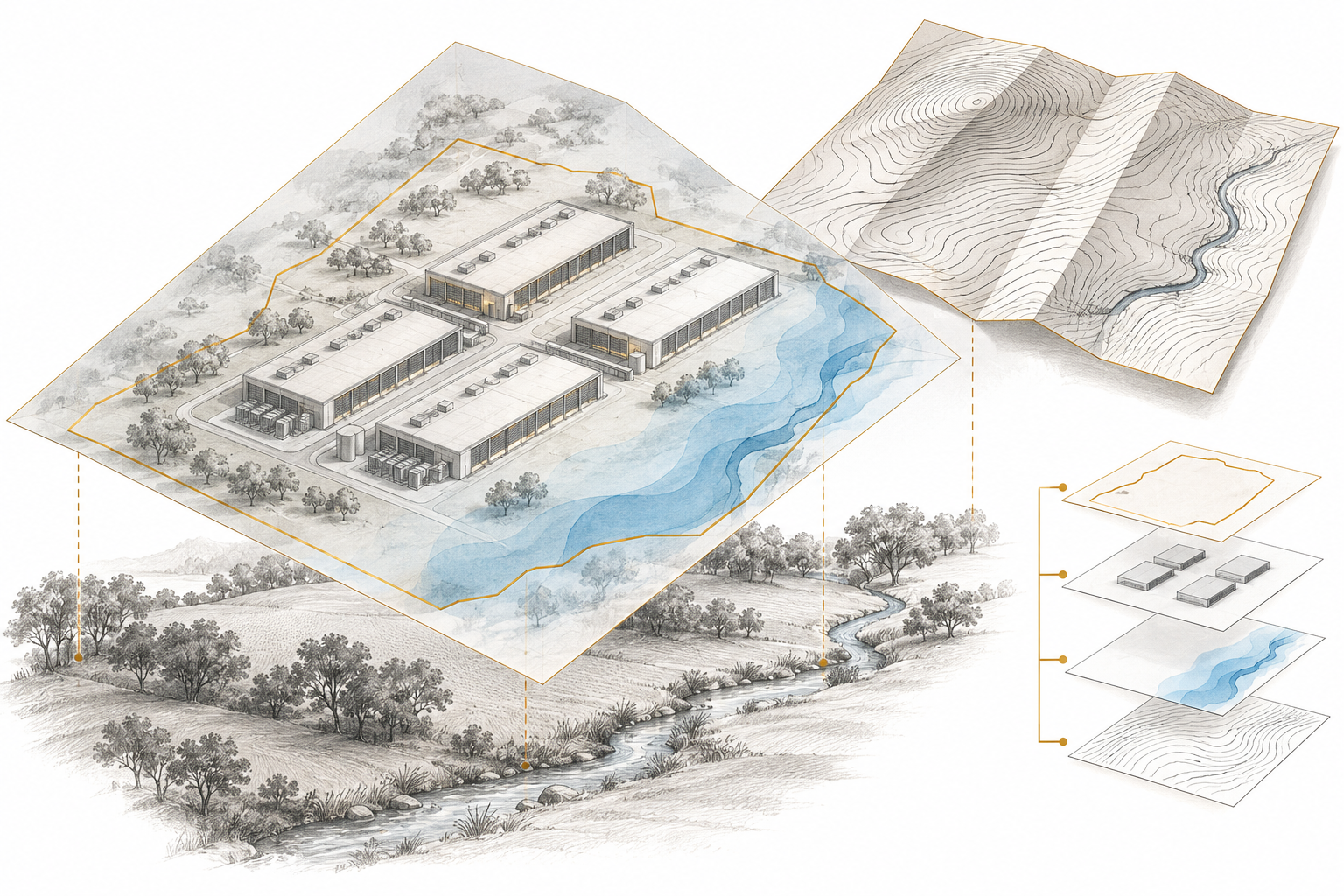
What does flood screening contribute to the study?
Screening adds a dated source to the early site comparison. It helps identify the questions your team needs to resolve before taking a campus option further.
The study records the boundary used, the source consulted and the extent of its coverage. If the evidence cannot be matched confidently to the site, the uncertainty stays visible. A convenient map point is insufficient when the development brief concerns a larger parcel.
Where does the US map evidence start?
The starting record is the relevant official flood-map information. The US Geological Survey directs readers to FEMA flood maps, including the FEMA Map Service Center, for this purpose.
For a site study, the record needs enough detail to locate the evidence again. The brief identifies the parcel or boundary, source link, check date and any map reference available. It also records whether the evidence covers the whole area being considered.
What does a mapped zone leave open?
A mapped zone leaves site-specific questions to resolve. It cannot be read as a guarantee that a proposed campus has no flood exposure.
The National Flood Insurance Program explains that flood losses also occur outside mapped high-risk areas. In a Keystone study, the screening result therefore stays attached to its scope and source. Missing drainage, levels or other site evidence is recorded as a gap.
This keeps the early comparison useful without turning it into a detailed flood or drainage design conclusion.
How does the evidence connect to campus options?
The study reads the available site-risk evidence beside the proposed campus arrangement. Your team can see which parts of an option depend on a point that remains unresolved.
The agreed scope records the relevant questions:
- Is the full study boundary matched to the source?
- Which proposed areas are covered by the screening evidence?
- What additional survey or drainage information is available?
- Which layout or cost assumptions depend on further checking?
- What evidence would change the preferred option?
The study preserves those questions with the comparison. It does not assume that a general map answers each one.
What should you send for the study?
Send the boundary, location, intended capacity and available site records. Include any survey, drainage or flood documents already held, with their dates.
Keystone's data-center study uses the agreed brief to connect site strengths and risks with campus options and commercial outputs. Read the USA phased-campus study brief for how the comparison keeps initial development and expansion assumptions visible.