
Two limits control how much you can build on a plot. They are easy to mix up.
- Coverage limits the footprint. It asks how much of the ground the building covers.
- FAR (or FSI) limits total floor area. It asks how much floor area counts across all floors.
One plot can hit either limit first. A designer must check both.
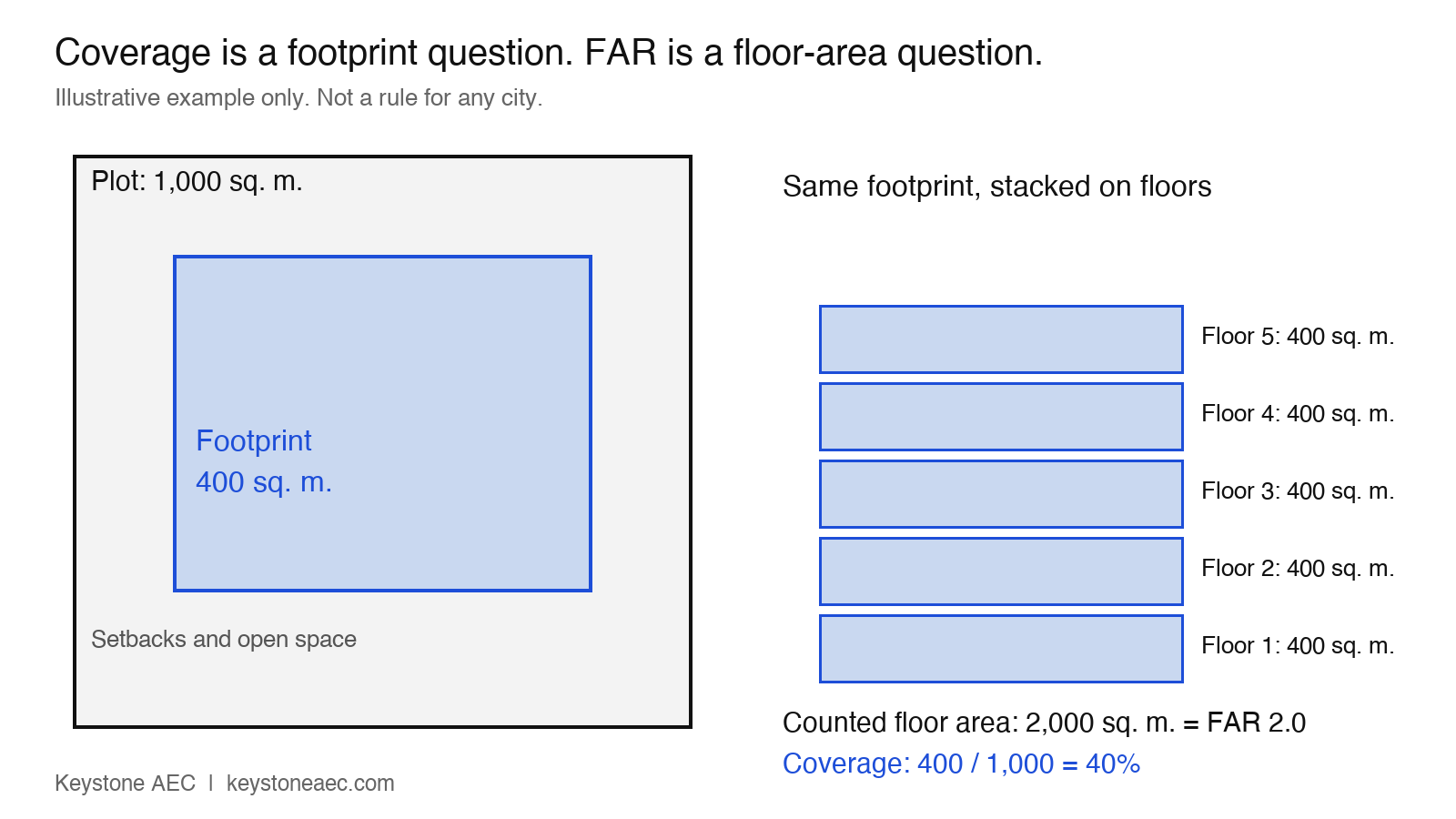
What does coverage mean?
Coverage is the part of the plot that a building covers when you look at it from above. Different places use different names: ground coverage, building coverage, site coverage and lot coverage. The idea is the same. The details are not.
New York City's Zoning Resolution gives one official wording. It defines lot coverage as the portion of a zoning lot that, viewed directly from above, would be covered by a building or any part of a building. It then lists exceptions for some calculations. See the official definitions.
That is one city's text. It is not a rule for other places.
How is this different from FAR?
FAR counts floor area. Coverage counts footprint.
The example above uses illustrative numbers, not a rule for any city:
| Item | Value |
|---|---|
| Plot area | 1,000 sq. m. |
| Footprint | 400 sq. m. |
| Coverage | 400 ÷ 1,000 = 40% |
| Floors, each equal to the footprint | 5 |
| Counted floor area | 2,000 sq. m. |
| FAR | 2,000 ÷ 1,000 = 2.0 |
Now change one input. If the local coverage limit is 30%, the footprint must shrink to 300 sq. m. Five floors then give 1,500 sq. m. To reach 2,000 sq. m., the building needs more floors, and height rules may not allow that. So coverage can cap the result before FAR does.
The reverse also happens. On a plot with generous coverage and a low FAR, the floor-area limit binds first.
Why does the local rule decide?
India's Model Building Bye-Laws are guidance. They do not set one binding value for every plot. The Ministry of Housing and Urban Affairs names state and local authorities as responsible for notifying and enforcing building bye-laws. See its official explanation.
So three things can change by place:
- The name and the definition. What counts as covered can differ. Balconies, porches, projections and basements are common points of difference.
- The limit. It can depend on plot size, land use and zone.
- How it combines with other rules. Setbacks, height and open-space rules act on the same plot.
Do not carry a coverage percentage from one city or state to another.
What should an early site review record?
- The governing source for coverage, with its date.
- The exact definition: what the footprint includes and excludes.
- The coverage limit and the FAR limit, written as two separate lines.
- Which of the two binds first, and by how much.
- Any item still unchecked.
A feasibility report that shows only FAR hides half of the question. Keystone AEC (https://keystoneaec.com) treats footprint and counted floor area as two checks, and marks any rule it could not source.
For the wider picture, see buildable area is not the same question as FAR and FAR and FSI are not a single number.