
A data center in Dominion Energy's Virginia territory will soon sign a different kind of power contract. The utility's new large-load rate class, called GS-5, ties a customer to a long term and a floor on what it pays. These terms change the cost of a site before it is built.
What the utility says
Dominion published a report on the class in May 2026. These are its statements, not ours:
- Start date: the State Corporation Commission approved the class and tariff, effective 1 January 2027.
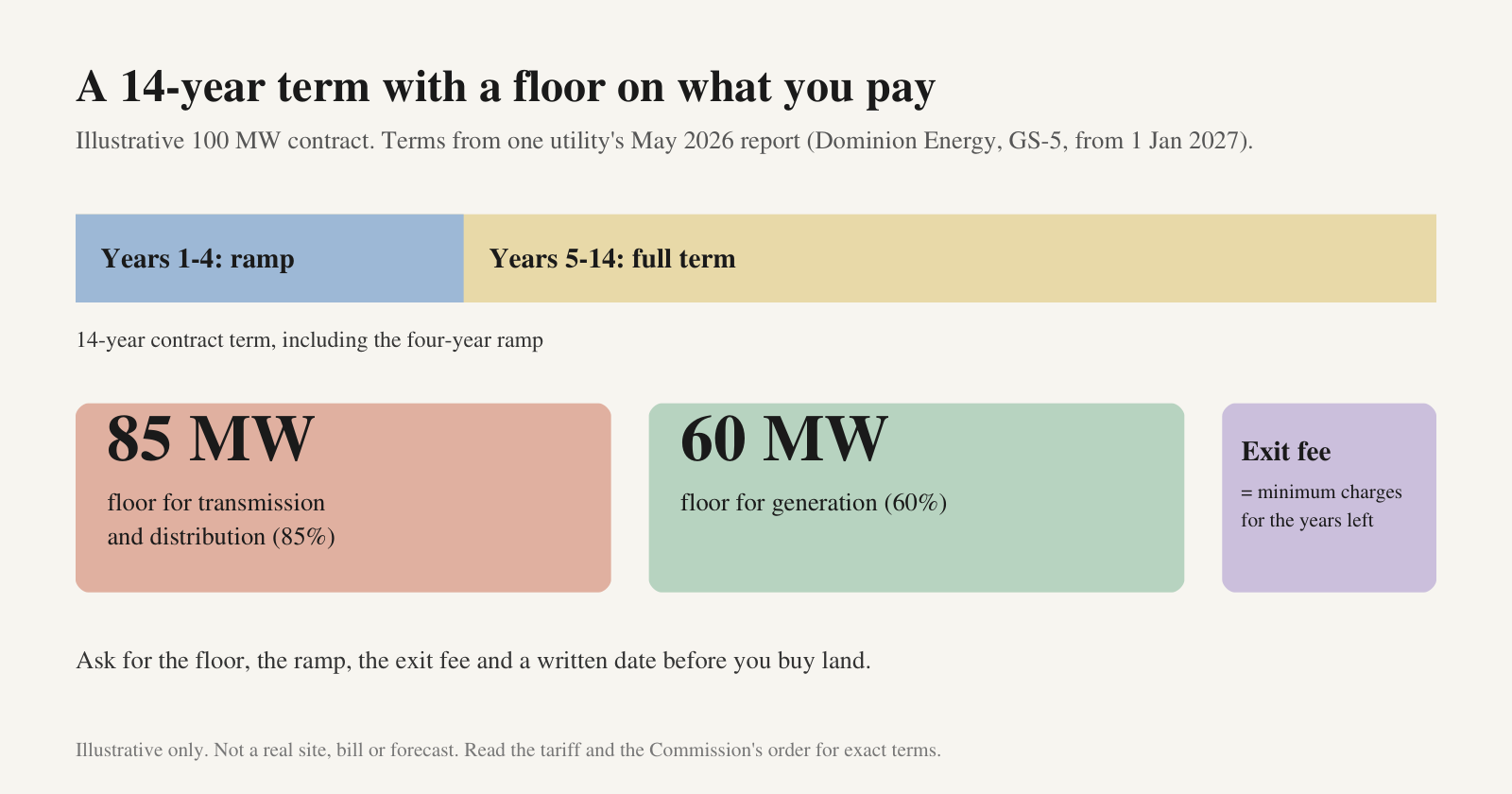
- Term: 14 years, which includes a four-year ramp period.
- Minimum demand charges: each month the customer pays the higher of its actual demand or a share of the demand it contracted. The share is 85% for the transmission and distribution functions and 60% for the generation function.
- Exit fee: a customer that stops before the end of the 14 years pays exit fees equal to the minimum demand charges that would have accrued over the unexpired term. The report adds that customers who stay for the full term still face minimum charges in later years.
- Reducing the contract: a customer can lower its contracted demand by 20% with 36 months' notice and no exit fee, or by up to 50% if the capacity can be reallocated to other customers.
- Deposits: a large-load agreement triggers cash deposits and covers 100% of costs incurred if the project is cancelled before power is on.
A worked example (arithmetic only)
Take a 100 MW contract at full size. The floors are:
- Transmission and distribution: 85% of 100 MW = 85 MW.
- Generation: 60% of 100 MW = 60 MW.
So even if the data center draws 40 MW in a slow month, the bill is built from 85 MW for the wires and 60 MW for generation, not from 40 MW.
If the customer stops after 6 years of the 14, 8 years remain. The exit fee equals the minimum charges for those 8 years. In MW-years that is 85 × 8 = 680 for transmission and distribution and 60 × 8 = 480 for generation, before any price per MW is applied. The numbers are for illustration. Your price and your contract decide the real figures.
What to ask before you buy land
- What is my contracted demand by year, and what is the floor in each year of the ramp?
- Which share applies to each function, and what is the term?
- What would an exit fee be at year 3, year 7 and year 10?
- How much can I reduce the contract, with what notice?
- What is the date the utility gives for my power, in writing?
Where the date comes from
The same report says the utility has given energisation dates to 25 gigawatts of new data centers through 2031. It has not yet given connection dates to a further 45 gigawatts. You can read a floor in the tariff. A date only comes from the utility.
What a study shows
A Keystone data center study shows how a floor and a long term change cost and returns for your load and ramp. It shows power as a need, not as a confirmed supply. Share a site boundary and your brief to discuss it.
Source: Dominion Energy, GS-5 Large-Load Rate Class Report, May 2026. Read the tariff and the Commission's order for the exact terms before you rely on any figure.
Read the full guide: data center site selection.