
If you are raising development finance, the lender will often send its own surveyor before any money moves. Their report decides how much the lender trusts your cost, your programme and your team.
This guide explains what that report checks, based on UK guidance for lenders' monitoring surveyors. Use it to prepare before the surveyor asks.
What the report is
The lender appoints a quantity surveyor or monitoring surveyor. Before the loan, this person does technical due diligence on the project. They write it up in an initial report. In UK practice that report is usually a condition precedent of the loan. Funds are not released until it is done.
The surveyor works for the lender, not for you. The report should say who can rely on it and that others cannot.
The nine parts of a typical report
The UK guidance uses this structure:
- Introduction: purpose, recipients and limits of the report
- Executive summary, as a risk register
- Project summary: parties, timescale, procurement, cost, approvals, funding limits
- Finance
- Programme
- Design
- Construction
- Contract
- Conclusion
Lenders may use their own template, but the questions are similar.
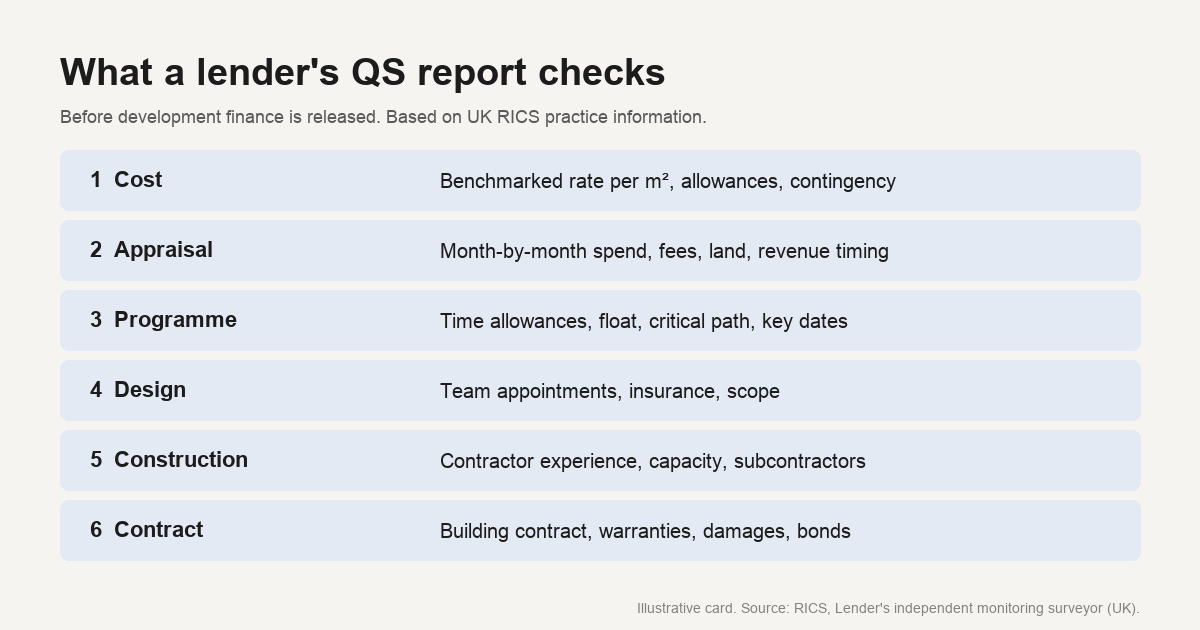
What the surveyor checks on cost
Is the construction cost enough? The surveyor benchmarks it. They express your cost as a rate per square metre and compare it with similar projects. They adjust for base date, location, ground conditions and external works.
How firm is the cost? They ask what stage your estimate is at. Is it a quantity surveyor's estimate on planning drawings? A pre-tender estimate on detailed design? Or a priced building contract?
What is not fixed? They look hard at budget allowances, provisional sums, prime cost sums and contingency. They also check enabling works, utility connections and site preparation.
Preliminaries and overhead. They comment on the share of cost for the contractor's preliminaries, overhead and profit.
Front loading. They check if early items are priced high to help cash flow. The aim is enough money left to finish at every point.
What they check in the appraisal
You will usually give them a development appraisal with a month-by-month spend for the whole project. It becomes the reference to track actual spend against forecast. Beyond construction, they look at:
- land, enabling works, demolition and site clearance
- planning and consents, including costs that follow from them
- professional and development management fees
- surveys and site investigations
- third-party costs such as party wall, rights of light and crane oversail
- legal, marketing and sales fees
- lender fees, interest and insurance
- tax cash flows, revenue timing and retention
On larger projects, drawdowns may be capped at the monthly amount in the agreed cash flow.
What they check on programme, design and contract
Programme. They want a master programme, a construction programme and a design programme. They check time allowances, float, logical order and the critical path. They set up a key date schedule to track progress each month.
Design. They review the design team's appointments, insurance, fees and scope. They do not take design liability.
Construction. They check the contractor's experience, capacity, team and subcontractors.
Contract. They read the building contract, warranties and agreements to lease. They look at damages for late completion and any performance bond.
How to prepare
Have these ready before the kick-off meeting:
- a cost plan in a standard structure, with the basis of each figure
- a list of every allowance, provisional sum and contingency, with what each covers
- a month-by-month appraisal that matches the programme
- the master, construction and design programmes
- design team appointments and insurance
- the building contract or the draft, with the procurement route
- known risks, stated plainly
The surveyor separates facts, other people's opinions and their own opinion. If your figures carry a source and a stated basis, there is less for them to question.
Where a study fits
A study does not replace the lender's surveyor. It can give you a clear starting position before you meet them: options for the site, cost, timeline, feasibility and returns, with the basis of each figure shown. See what a development underwriting report should disclose.
Sources
- RICS, Lender's independent monitoring surveyor, practice information, UK, 1st edition March 2015, reissued September 2025 (sections 3.2.1 to 3.2.11 read 26 November 2026).