
A warehouse site can look right on a map and still fail on one check. The land may not allow the use. The truck court may be too small. The power may not match the load.
Run the checks in an order that removes weak sites early. The cheapest check is the one that can end the search.
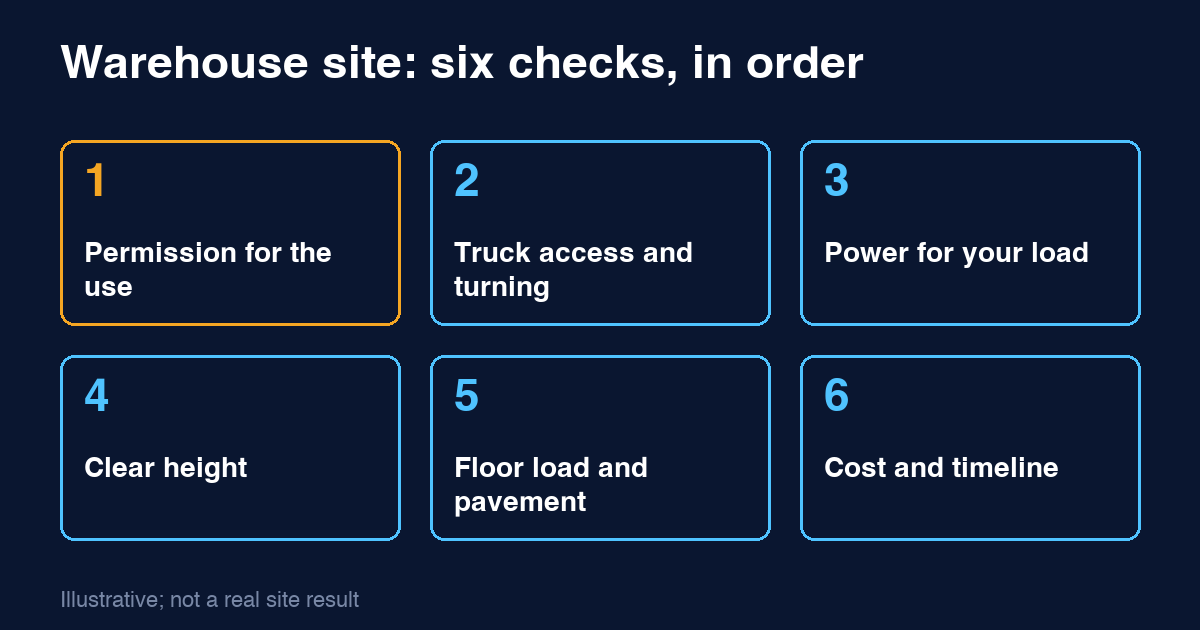
The checks, in order
| Check | What to confirm | Why it comes here |
|---|---|---|
| Permission for the use | The land can be used for a warehouse, and which approval applies | A "no" ends the search |
| Truck access | The route, the truck court and the turning space for your largest truck | Poor access cannot be fixed later |
| Power | The load you need and who can supply it | Power can limit what you can run |
| Clear height | Height to the lowest obstruction, not to the ceiling | Sets stacking and fire protection |
| Floor load and pavement | What the floor and the yard must carry | Heavy racking and trucks need it |
| Cost and timeline | A range for each, with the assumptions shown | Shows whether the site pays |
Why each check matters
Permission. Industry guides put zoning first. Link Logistics advises confirming the site is zoned for industrial use and, if it is not, asking how likely a variance is and how long it takes. Rules differ by state and by authority, so confirm with the local authority. See also industrial zoning is not permission.
Truck access. A dock does not mean the truck court works. The court must let the largest truck you expect to turn and back in. The same guides ask whether smaller vehicles, such as vans, need their own docks.
Power. Power is easy to forget in a listing. Ask for the available supply and match it to the load of your operation, including any cold storage, charging or automation.
Clear height. Clear height is measured to the lowest obstruction. It also drives the fire suppression design, so settle it before the building is fixed.
Floor load and pavement. Check what the floor must carry and whether the yard needs heavy-duty pavement. Heavy racking and loaded trucks put the most load on the floor and the yard, so agree the loads with your engineer early.
What the sources do not settle
These are checklists written by brokers and engineers. They agree on the order of the main checks, but they do not give one set of limits. Heights, truck sizes and load limits vary by market and by use. Treat any figure as a prompt to ask, not as a rule for your site.
Where to start
Start with the permission check, then compare sites on the same terms. For the wider approach to an industrial or warehouse plot, see AI for industrial and warehouse development.
What the study gives you
A Keystone warehouse study takes a site and your brief. It shows location checks, feasibility, cost and timeline together, with each finding marked measured, assumed or not checked. Permission, power and local approvals stay on the open list until the authority and the utility confirm them in writing.