
Many developers look at state policy for the incentives. A second document is worth reading first: the list of proof a state may ask you for. If you know that list early, you can check a site against it before you spend on design.
In October 2026, NITI Aayog's Frontier Tech Hub published a framework for states to evaluate data centre proposals. It is a guide, not a law. The document says it supports decisions and adds no new regulation. But it shows what states are being told to look for.
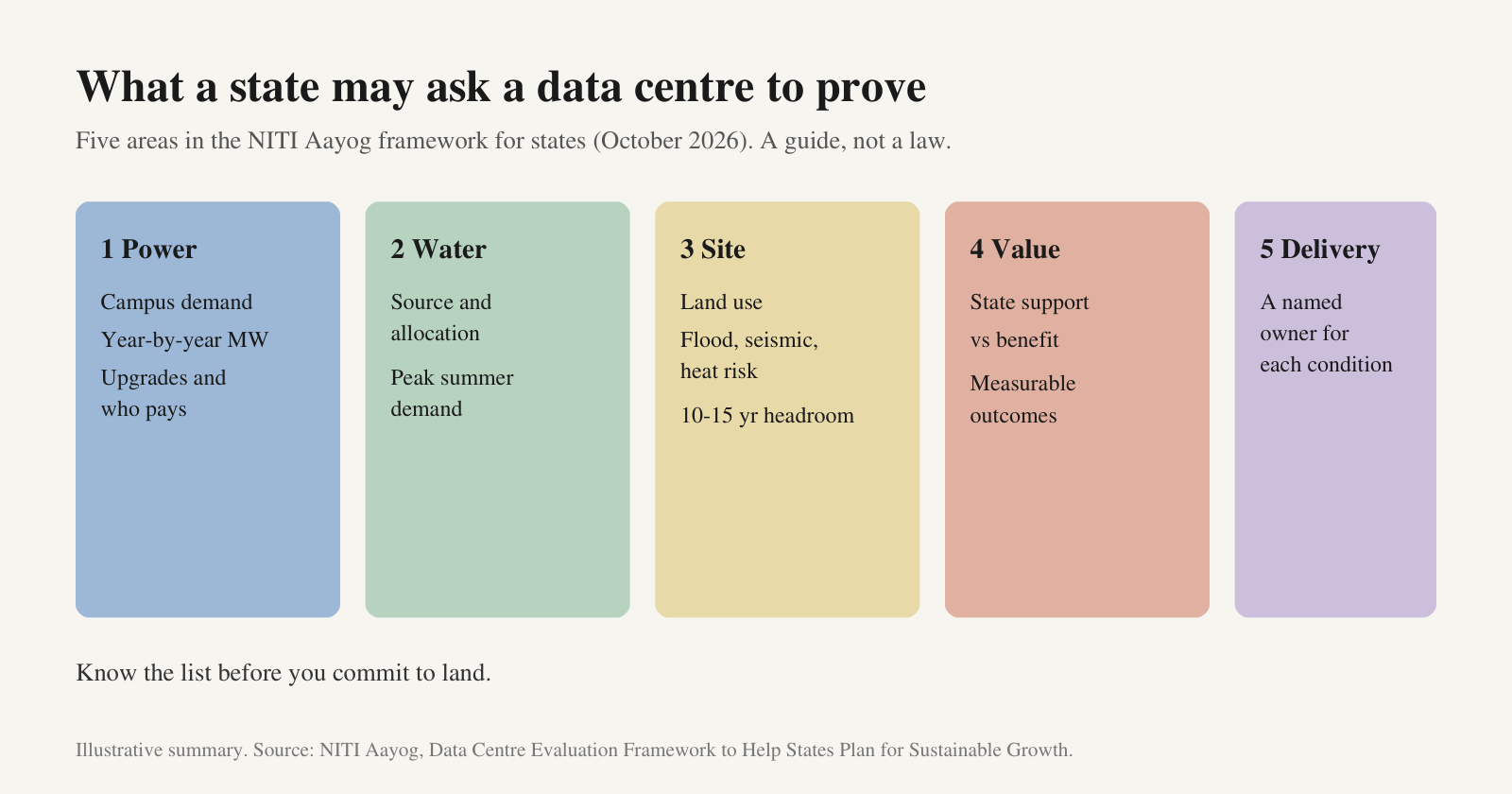
The five areas, in plain words
1. Power. The framework suggests the developer, the distribution company and the transmission utility agree one plan together. It covers the full campus demand, the megawatts sanctioned, the year-by-year energisation, and the substation and line upgrades with their lead times. It also asks for load-flow studies and a plan for who pays for each upgrade. For facilities above 20 MW it suggests demand-response readiness and live data links to the state load dispatch centre, subject to grid code.
2. Water and cooling. It asks for a long-term view of where the water comes from, an agreement among the water authorities, and a phase-by-phase supply plan. It asks you to model peak summer demand, including temperatures around 40°C where they apply. Recycled water counts only when it is contracted, connected and available from the day you commission.
3. Site and environment. It asks for forward-looking flood, cyclone, seismic, heat and ecological risk, not only today's hazard maps. Large campuses may need a community impact assessment. It also asks for a record of land use, grid, water, fibre and right-of-way headroom for 10 to 15 years.
4. Economic value. States are asked to compare the support they give with the benefit they get, and to pay against measurable outcomes.
5. Delivery. Each condition goes to a named responsible party. States are asked to publish an approval list with the issuing authority, time and documents for each approval.
What this means for a site check
Most of the proof above is about one site, not a city. A short checklist you can run before you commit:
- Do you have a power plan with dates and a named upgrade owner, or only a stated megawatt figure?
- Is there a water source with a contract and a peak-summer figure?
- Is the land use recorded, and is there room to expand for 10 years?
- Which hazards apply to this plot, now and later?
- Which approvals does your state list, and who issues each?
A map or a regional average does not answer these. A letter, a record for the parcel, or a study does.
One state as an example: Uttar Pradesh
Uttar Pradesh published a Data Centre Policy in 2026. Its official page lists these points (page last updated 10 October 2026):
- Three types by size: parks of at least 40 MW; units above 2 MW and below 40 MW; edge sites of at least 10 locations of 50 kW or more with a combined load of 2 MW.
- Subsidies: up to ₹50 crore interest subsidy for parks, up to ₹20 crore capital subsidy for units.
- Land: a subsidy of 25% in two regions and up to 50% in two others.
- Duties: full stamp duty exemption on purchase or lease from government authorities, and electricity duty exemption for 10 years.
- Power charges: transmission and wheeling charge exemption of up to 100%, depending on the source of renewable power and the policy terms.
These are the headline terms on the state page. Who qualifies, and when, sits in the policy text. Check it, and check the same details for any other state you consider.
Where a study fits
A Keystone data centre study shows a site's strengths and risks, campus options, power needs, cost, timeline and returns side by side. It shows power as a need, not as a confirmed supply. It helps you see which of the proof items above are open for your site.
To discuss a study, send a site boundary and your brief.
Sources: NITI Aayog, Data Centre Evaluation Framework to Help States Plan for Sustainable Growth (October 2026); Invest UP, Uttar Pradesh Data Centre Policy 2026.
Read the full guide: data center site selection.